Tuesday, 1 October 2013

Combined cycle Adv. & Disadv.

Main features


- Combined cycle power generation combines 2 cycles for operation, namely the gas
turbine cycle and the vapour power (or steam turbine) cycle.

- In a gas turbine power plant, natural gas and compressed air undergo combustion.
The resultant high pressure gas drives the gas turbine which in turn produces
electricity. Although it is clean and fast in starting up, the gas turbine power plant
suffers from low thermo efficiency of about 25 to 30% (4). Much of the energy is
wasted in the form of gas turbine exhaust.

- The combined cycle power generation makes use of the merits of the high

temperature (1100 to 1650°C) gas turbine cycle and the lower temperature (540 to
650°C) steam turbine cycle (5). The hot exhaust gas from the gas turbine, instead of
being released as waste, is captured and channelled to the steam turbine where

steam is heated by the exhaust to drive the turbine

There are various types of combined cycle power generation : 

- combined cycle with supplementary firing,
- combined cycle with regeneration,
- combined cycle with feedwater heating,
- combined cycle with multipressure steam cycle
- combined cycle for nuclear power plants


Advantages : 

As most combined cycle generation systems use natural gas as the fuel, the
environmental emissions are low.Transportation of fuel via pipelines is also easier than that of coal and oil.

- It is also cheaper to build a combined cycle power plant than coal, nuclear or renewable energy power plant .

- The combined cycle power generation system also offers quick part-load starting.

- Fast Ramp Rates :  51 MW per minute ramping capability and improved load adjustment capability ..  !!


- To reduce CO2 emissions : above 50 %


Disadvantages : 

- colorless and an odorless substance, detection of gas leaks can be difficult...

As natural gas is the fuel used, its higher cost compared to coal and oil will result in higher operating cost ..

Also, the combined cycle power generation system is a combination of two
technologies, the complexity will result in higher maintenance cost ..and also it will require highly skilled and better trained operating staffs

The capital cost of a combined cycle power generation plant is higher than that of gas turbine plant


Combined Cycle components : 

note : 
http://www.scribd.com/doc/53730177/Combined-Cycle-Gas-Turbine


My first search Project !! ... general notes

Notes:

- Efficiencies of rankime cycle !!

  • Actual steam Cycle >>>  36% -  37% 
  •  If we increased Boiler pressure & temperature  >>>> 37% Jump to 43 % 
  • Ideal Reheat >>> 43% Jump to 45 % 
  • [OFWH] Ideal regenerative >>> 43% Jump to 46.3%
  • IF OFWH+CFWH+REHEAT >>> 45% Jump to 49.2%

 - To Increase the efficiency of Rankine Cycle :

  • Increase the average temperature at which heat is transferred to fluid (Bolier) .
  • Decrease the average temperature at which heat is rejected from fluid . 

BY :

  1. Lowering the pressure of the condenser (Tlow avg ) .
  2. Superheating steam to high temperature (T high avg) .
  3. Increase Boiler pressure (Tavg high) . >> Defect >> more moisture >>> solution >> reheat on 2 stages OR high temperature Boiler  [Unsafe] . 


- What is Entropy ?? 

- the answer >>> http://dreamtorealtransducer.blogspot.com/2013/09/what-is-entropy.html

 Notes :
- S.S.C >> specific STEAM consumption >> KG/S  /  KW
  S.F.C >> specific FUEL consumption >>  KG/S  /  KW


- Feed water heater : [ Heat exchangers ] !!

OFWH >> open feed water heater
Deaerator is OFWH  !! >>> specifically designed to remove non-condensable gases from the feedwater.

CFWH >> closed feed water heater
shell and tube heat exchangers

why do we use FWH ??
>> To reduce the irreversibilities involved in steam generation !! and therefore improves the thermodynamic efficiency of the system ....
This reduces plant operating costs and also helps to avoid thermal shock to the boiler metal when the feedwater is introduced back into the steam cycle.


fossil- and nuclear-fueled power plants.
WHYY ?!!! :((


What is the irreversibility ?!!!

 >> when the system change from one phase to another it's molecular form change ....
so it can't return exactly to it's first form as entropy of system and surrounding change also ..

Notes :
Regenerative Rankine Cycle >>> to heat the outcome of condenser with hot steam from turbine !!
Reheat Rankine Cycle >>> reheat the steam in turbine !!
Bleed steam !! >>> steam between turbine stages !!

Ref. :
ref. :
--------------------------------------------------------------------------------------------------------------------------------


Economizer ! 

- Intended to reduce energy consumption
- Economizer has the same function of FWH but with different technique !!
  not apply to nuclear plants !!
- considered as heat exchanger !!
- Used in Boiler & HVAC .
- act as heat recovery to increase temperature of condensed water below Boling Point . 
- Economizers designed for natural gas only.. 
- It would plug up if installed to coal boiler and corrosion to oil boiler..

Condensing Economizer

In Natural Gas :

- This design is capable of condensing moisture of boiler exhaust gas ..
- 10% of heat is lost as latent heat as H2 is combined with O2 !!
- 12% of weight of exhaust >>> water vapour formed !!
- Correct application of heat recovery ... exhaust gases is cooled to below the dew point of water vapour ..      condense water and release the trapped energy .. [EXOTHERMIC]
- Boiler Economizer >> Increase boiler efficiency as it use the sensible heat of exhaust gases
- Condensing Economizer >> Increase boiler efficiency [95%] as it use the latent heat of exhaust gases
The economizer is made of an aluminum and stainless steel alloy
- It condensed 11% of water contained in the gases !!

ACIDIC PROBLEMS ???!!!!!!  :(((((

Ref. : http://en.wikipedia.org/wiki/Economizer
ref. :  http://www.bewaterwise.com/icp/Condensing%20Boiler%20Economizers.pdf
--------------------------------------------------------------------------------------------------------------------------------

Deaerator : 

- Used to remove corrosive compounds as O2  and CO2 and other dissolved gases  !!
as they cause serious corrosion damage in steam systems by attaching to the walls of metal piping and other metallic equipment and forming oxides (rust) ... !
- CO2 + H2O >> carbonic acids !
- O2 is removed till 7 PPB !
- The deaerators in the steam generating systems of most thermal power plants use low pressure steam obtained from an extraction point in their steam turbine system.

1- Tray Type :

- Horizontal with vertical Domed !

- Boiler feedwater enters the vertical deaeration section above the perforated trays and flows downward through the perforations .

- The steam strips the dissolved gas from the boiler feedwater and exits via the vent at the top of the domed section.

- Some designs may include a vent condenser to trap and recover any water escape !..

- Low-pressure heating steam, which enters the horizontal vessel through a sparger pipe in the bottom of the vessel, is provided to keep the stored boiler feedwater warm .

-External insulation of the vessel is typically provided to minimize heat loss.


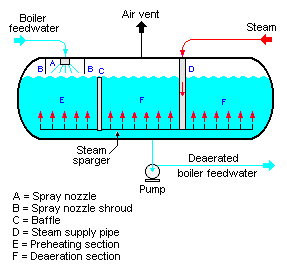
2- Spray Type : 


- preheating section (E) and a deaeration section (F) .

- The two sections are separated by a baffle (C).

- The boiler feedwater is sprayed into section (E) where it is preheated by the rising steam from the sparger.

- The purpose of the feedwater spray nozzle (A) and the preheat section is to heat the boiler feedwater to its saturation temperature to facilitate stripping out the dissolved gases in the following deaeration section.

- The preheated feedwater then flows into the dearation section (F), where it is deaerated by the steam rising from the sparger system. The gases stripped out of the water exit via the vent at the top of the vessel

- Some designs include vent condenser to trap water vapour that may escape ..

Ref. :  http://en.wikipedia.org/wiki/Deaerator

--------------------------------------------------------------------------------------------------------------------------------


Boiler Feedwater Pump:


Make up Water :


Water is purified by :


Daerator - oxygen scavenger - alkalized to ph 9.0 or higher to reduce oxidation and to support the formation of a stable layer of magnetite on the water-side surface of the boiler protecting the material underneath from further corrosion. This is usually done by dosing alkaline agents into the feedwater, such as sodium hydroxide (caustic soda) or ammonia....

ORC (Organic Rankine Cycle ) !!  [Lower efficiency]

uses an organic fluid such as n-pentane or toluene


Need to be searched !! 

- Mercury Vapour Turbine !! 
Saturation temperature and pressure